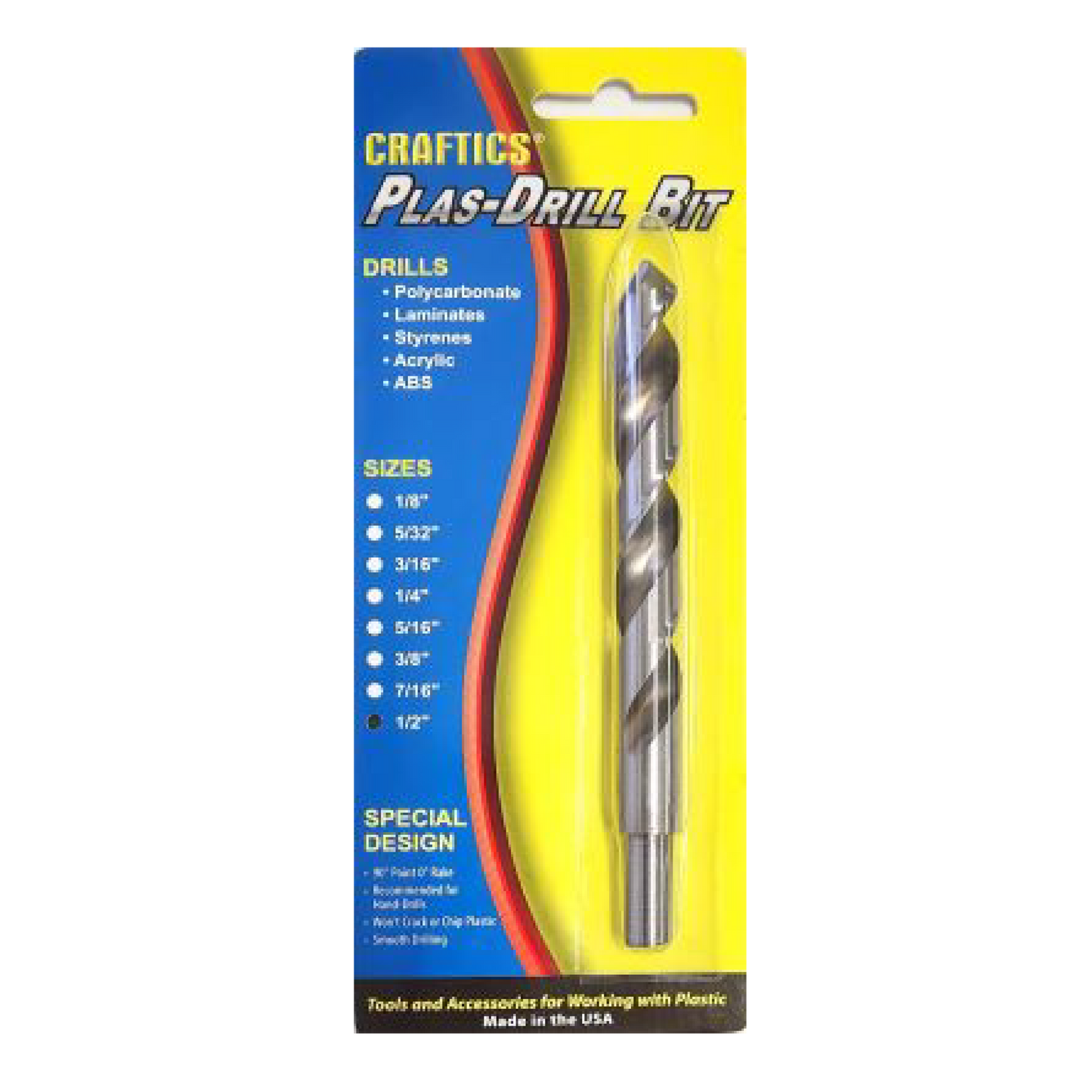
Description
1/2 Inch Plastic Drill Bit is specifically designed for drilling clean, chip-free holes in acrylic, polycarbonate, and other plastic materials. Unlike standard drill bits made for wood or metal, this specialized bit features a 90° point angle and 0° rake angle that prevents cracking, chipping, and stress fractures common when using conventional bits on plastics. The geometry cleanly slices through plastic without grabbing or melting the material, even at this larger diameter.
ShapesPlastics' 1/2" plastic drill bit is made from high-speed steel (HSS) for durability and features a 3/8" shank diameter to fit standard drill chucks while providing the strength needed for larger holes. Works excellently with both hand drills and drill presses. Perfect for drilling large mounting holes, pipe clearance holes, or any application requiring precise 1/2" holes in acrylic sheets, polycarbonate panels, HDPE, ABS, PVC, and other thermoplastics. This heavy-duty size is essential for large hardware, structural applications, and industrial fabrication. Professional fabricators rely on this specialized bit for clean results in demanding applications.
Features
- 1/2 inch (0.500") diameter
- 90° point angle for accurate starting
- 0° rake angle prevents chipping
- High-speed steel (HSS) construction
- 3/8" reduced shank for standard chucks
- Produces clean, chip-free holes
- Works with hand drills and drill presses
- Designed specifically for plastics
- Prevents stress cracks
- Heavy-duty professional quality
Applications of 1/2" Plastic Drill Bit
- Acrylic Sheet Drilling
- Polycarbonate Panel Holes
- Heavy-Duty Structural Holes
- Large Bolt Clearance
- Pipe and Cable Pass-Through
- Marine Board Drilling
- Industrial HDPE Fabrication
- Thick Material Applications
- Large Hardware Installation
- Manufacturing & Production
Frequently Asked Questions
Why does this bit have a 3/8" shank instead of 1/2"?
The reduced 3/8" shank allows the 1/2" bit to fit in standard 3/8" and 1/2" drill chucks, which are most common on hand drills and drill presses. This design provides maximum compatibility while maintaining the strength needed for drilling larger holes. The shank is sized to handle the torque generated by the 1/2" cutting diameter.
What's the best technique for drilling 1/2" holes in plastic?
Use low speeds (200-800 RPM) and very light pressure. Start with a smaller pilot hole (1/8" or 1/4"), then step up to 1/2". This reduces stress and heat buildup. Back out frequently to clear chips and allow cooling. Clamp material firmly with backing support. For thick materials over 1/2", drill from both sides to meet in the middle, preventing blowout.
Can I use this on thick acrylic or polycarbonate?
Yes, but proper technique is critical. Always drill a pilot hole first with a smaller bit. Use very slow speeds and minimal pressure - let the bit's weight do most of the work. For materials over 3/4" thick, drill from both sides to prevent stress. Clear chips frequently and allow cooling time. A drill press provides better control than a hand drill for this size.
Why can't I use a regular 1/2" drill bit on plastic?
Regular bits grab aggressively and generate enormous stress at 1/2" diameter, almost guaranteeing cracks, shattering, or melting. The 0° rake angle on plastic bits is essential at larger sizes - it cleanly shears through plastic without grabbing. Standard bits will ruin expensive plastic sheets and can be dangerous as material binds and spins. Always use plastic-specific bits for holes this large.